How 3PL Logistics Helps eCommerce Businesses Scale
Retail has changed dramatically over the past decade. Online shopping continues to grow, creating new opportunities for businesses to reach customers anywhere in the world. However, with that opportunity comes a major challenge: logistics.
Getting products from a warehouse to a customer quickly and efficiently is what determines success in today’s eCommerce environment. Brands that can ship fast, track accurately, and adapt to demand spikes will win; those with rigid, costly in-house operations will struggle to keep up. That is where third-party logistics providers come in.
TL;DR
Third-party logistics (3PL) providers like QRC Logistics take warehousing, fulfillment, and distribution off your plate so you can focus on selling and growing. For eCommerce brands, the advantages are real: lower overhead, scalable infrastructure, EDI-powered automation, flexible dropshipping, and a ready-made Canadian distribution network that makes cross-border expansion straightforward.
QRC Logistics helps businesses simplify operations, reduce costs, and scale faster by handling warehousing, fulfillment, and distribution — so the people building the brand can stay focused on exactly that.
The Strategy of Specialization
One of the biggest advantages of working with a 3PL is specialization. Instead of trying to manage inventory, shipping, and distribution internally, businesses can rely on experts who do this every day. At QRC Logistics, established systems and processes are already in place to support efficient warehousing and distribution — systems that took years to build and refine.
The concept is straightforward: you focus on selling and growing your business, while your logistics partner handles fulfillment. This division of labour delivers two major benefits. First, your supply chain is managed by experienced professionals who understand how to optimize performance at every stage. Second, outsourcing logistics significantly reduces overhead costs. Maintaining your own warehouse, staff, and systems is expensive — a 3PL spreads those costs across multiple clients, passing savings back to each one.
The result is a more efficient, cost-effective operation that frees your team to focus on what matters most. If you are evaluating whether this model fits your business, it also helps to understand the different types of 3PL providers available, since each has a distinct scope of services.
One thing many businesses overlook when comparing providers is total cost. A lower per-unit rate does not always translate to lower total spend. The hidden costs of 3PL in Canada — things like minimum volume fees, receiving charges, and technology integrations — can significantly change the math. It pays to look at the full picture before signing.
eCommerce Fulfillment That Keeps Up
In eCommerce, the sale is not complete until the product reaches the customer. Fast, accurate fulfillment is critical. Customers expect quick delivery, real-time updates, and a seamless experience from checkout to doorstep. A single bad delivery experience can cost a repeat customer — and in an age of public reviews, potentially many more.
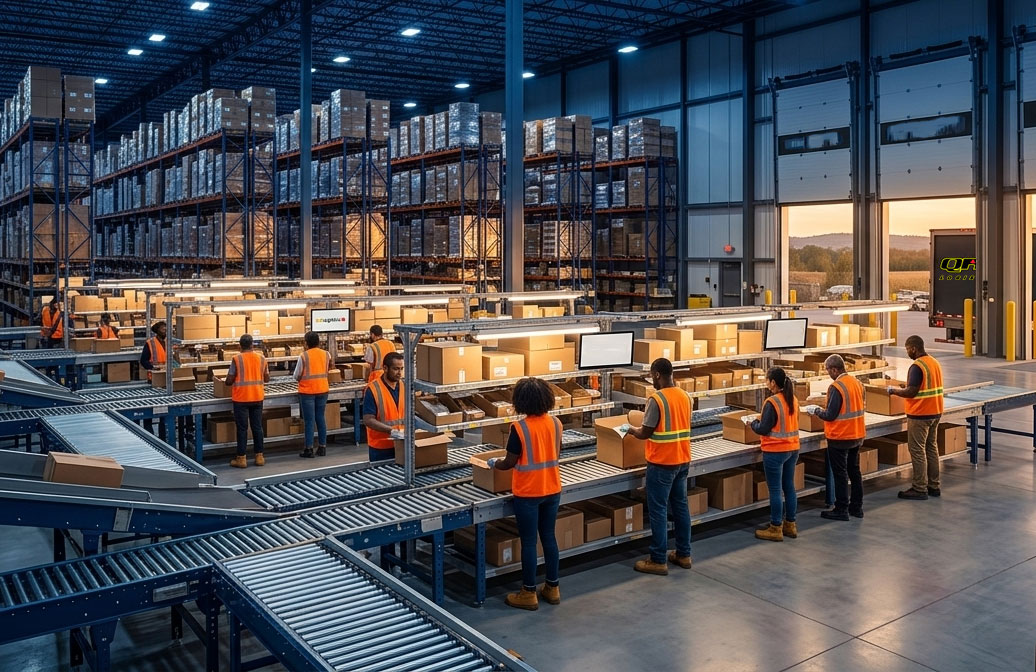
QRC Logistics supports eCommerce businesses with a Canada-wide distribution network designed to meet these expectations. With scalable systems in place, businesses can handle higher order volumes without sacrificing speed or accuracy. As demand increases, QRC adapts with you. This flexibility ensures your logistics can keep up with your growth, whether that means handling a seasonal spike or a sustained period of rapid expansion.
Good eCommerce fulfillment also depends on having your inventory data right. Warehouse inventory accuracy directly affects order fill rates, prevents overselling, and eliminates the customer service burden that comes with misshipments and delays. QRC’s inventory controls are built to deliver that accuracy at scale.
It is also worth understanding that most fulfillment failures are preventable. Misshipments — sending the wrong item, wrong quantity, or to the wrong address — are more common with manual processes and can be significantly reduced with the right systems and fulfillment partner in place.
EDI Integration for Faster, Smarter Operations
Technology plays a key role in modern logistics, and Electronic Data Interchange (EDI) is one of the most powerful tools available to eCommerce businesses. EDI allows companies to exchange documents and data instantly — orders, invoices, and shipping updates move automatically between systems, eliminating manual processes and the errors that come with them.
With EDI integration, businesses can manage operations more efficiently. There is less room for human error, faster communication between parties, and improved visibility across the entire supply chain. For high-volume eCommerce brands, this level of automation is not a luxury — it is a requirement for staying competitive. Managing dozens of orders manually is manageable; managing thousands is not.
This level of automation is especially important for companies that want to scale without adding unnecessary complexity or headcount. The right technology stack, backed by an experienced 3PL, makes growth feel like an opportunity rather than an operational crisis.
Dropshipping for Greater Flexibility
Dropshipping is another way businesses can simplify their operations and reduce the capital tied up in inventory. Instead of holding large quantities of stock, businesses can purchase products as needed and rely on a logistics partner to handle storage and fulfillment. This reduces upfront costs, minimizes the risk of dead stock, and keeps the business agile in response to changing demand.
QRC Logistics offers dropshipping services that allow businesses to stay flexible while maintaining reliable fulfillment. Orders are processed and shipped directly to customers, giving your team more time to focus on marketing, sales, and customer experience — the areas that actually differentiate your brand in a crowded market.
Dropshipping also pairs well with strong eCommerce inventory management practices. Knowing what is in stock, what is on order, and where it is located at any given moment allows for smarter purchasing decisions and more reliable delivery timelines.
Expand Into New Markets With Confidence
Expanding into a new country can be a complex and expensive undertaking. There are regulations, customs requirements, shipping infrastructure gaps, and market differences to consider. Getting it wrong can mean delayed shipments, unhappy customers, and regulatory headaches that slow everything down.
A 3PL partner removes much of that friction. QRC Logistics works with a growing number of U.S.-based companies looking to establish a presence in Canada. By acting as a local distribution partner, QRC handles inventory management, returns, and fulfillment within the Canadian market — without requiring the brand to build any infrastructure from scratch.
This is particularly valuable given the nuances of cross-border final-mile delivery into Canada. The final leg of a shipment — from distribution centre to customer door — is often the most complex and most visible part of the experience. QRC’s network is built to handle it reliably.
For U.S.-based 3PLs already operating on their side of the border, QRC also serves as a final-mile logistics partner in Canada, extending your reach without requiring you to build out your own Canadian infrastructure. This is how smart operators grow their geographic footprint without taking on proportional operational risk.
And if you are earlier in the decision process — still comparing your options or building a business case internally — the guide to choosing the best 3PL company in Canada walks through the key criteria that matter most for eCommerce and cross-border businesses.
In-House vs. Outsourced: Knowing When to Make the Switch
Many businesses start by managing logistics in-house. In the early stages, it makes sense — volumes are low, the team can handle it, and keeping operations close feels safer. But as order volumes grow, so does the complexity. Warehouse space fills up. Fulfillment errors increase. Staff are stretched across too many responsibilities.
The decision to outsource is rarely about whether a 3PL does it better in theory — it is about whether the business can keep pace with growth while doing it internally. The comparison of in-house warehousing versus 3PL comes down to a few key factors: flexibility, cost at scale, access to technology, and where your team’s time is best spent. For most growing eCommerce brands, the math tips toward outsourcing earlier than expected.
It is also worth understanding what common 3PL logistics challenges in Canada look like — geography, seasonal demand, carrier variability — so you can evaluate any partner’s ability to handle them before committing.
Why Businesses Choose QRC Logistics
QRC Logistics stands out because of its commitment to flexibility, efficiency, and genuine client success. This is not a one-size-fits-all operation. Every client relationship is built around understanding specific business needs and building logistics solutions to match.
Businesses choose QRC because they offer:
- Scalable warehousing and distribution warehouse services
- Canada-wide fulfillment capabilities for eCommerce brands of all sizes
- Advanced logistics technology including EDI integration
- Customized solutions tailored to each client’s specific needs
- Reliable support for both domestic and cross-border operations
- A proven track record, including real-world results in nationwide distribution case studies
Whether you are a growing eCommerce brand or an established company looking to optimize your supply chain, QRC provides the expertise needed to move forward with confidence.
The Right Logistics Strategy Creates Opportunity
The right logistics strategy does more than move products — it creates room for growth. When fulfillment is handled by experienced professionals using proven systems, your team can put their energy toward marketing, product development, customer experience, and the things that actually build a brand.
By partnering with a 3PL like QRC Logistics, businesses gain the freedom to focus on growth while leaving the complexities of logistics to the experts. This allows for faster expansion, improved customer experiences, and stronger overall performance. As eCommerce continues to evolve and customer expectations continue to rise, businesses that invest in efficient, scalable logistics will have a clear and lasting advantage over those that do not.
The question is not whether logistics matters. It does, more than ever. The question is whether it makes sense to build and manage that capability yourself — or to partner with people who have already done it.
Ready to Simplify Your Logistics?
Talk to the QRC Logistics team about warehousing, fulfillment, and Canada-wide distribution built around your business.